
XRF Multi-Stream Slurry Elemental Analyzer
Online X-ray fluorescence analysis for slurry grade monitoring, from single-stream measurement to engineered multi-stream sampling and process-control integration.
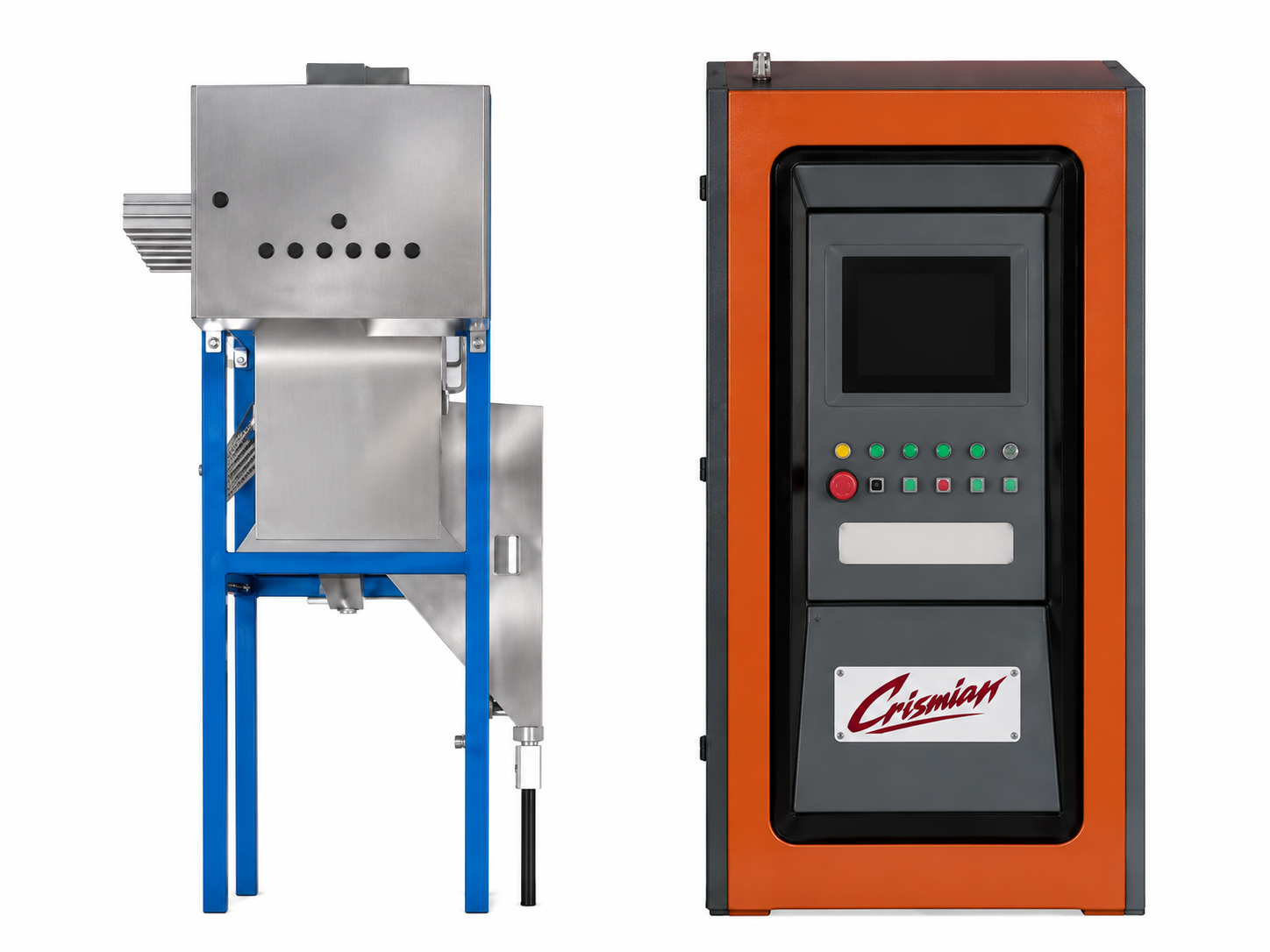
From characteristic X-rays to process decisions
Crismian XRF identifies elements and estimates their concentrations from the energies and intensities of characteristic X-rays emitted by a slurry sample. Energy-dispersive analysis follows the relationship between atomic number and characteristic X-ray energy described by Moseley’s law. Results are displayed online for metallurgy, mineral processing and chemical engineering applications.
Designed around the sample
Faster grade visibility
Conventional laboratory routes can require sampling, drying, sieving, grinding and preparation before assay. Online XRF shortens this delay; the literature describes 1–3 minutes per stream, with a configurable 1-minute reference measurement.
A representative measurement
The measuring cell is arranged to maintain fluidity and even mixing, so the analyzed sample more closely reflects the process slurry. Sampling and conditioning remain essential to the final result.
Spectral separation
Nuclear-electronics and spectrum-processing methods analyze complex spectra from multiple excited elements and compensate for inter-element interference.
Practical detector technology
The SDD design provides high resolution and count rate at room temperature, avoiding the liquid-nitrogen arrangement described for conventional lithium-silicon detection. This reduces the associated field-maintenance burden.
Built for process variation
The product literature describes adaptability to particle-size, concentration, bubble, flow-speed and stratification changes. Validate these effects against the actual slurry and calibration, rather than treating them as zero-error conditions.
Operation and maintenance
Local display, operator software, stable measurement and convenient servicing support continuous operation. A host computer can connect visualization, central control and remote-service functions.
One connected analysis chain
A configurable sampling, measurement and control architecture
- 01Sample
Process sampler and flow conditioning
- 02Select
Multiplexer and representative sample cell
- 03Analyze
X-ray excitation, SDD detection and spectrum processing
- 04Return
Demultiplexer and process return
Local operator display · Host computer · PLC / central control · Remote service
Measurement performance
| Parameter | Technical detail |
|---|---|
| Measurement time | 1 min reference, configurable; application description also cites 1–3 min per stream |
| Element coverage | Atomic numbers 20–92 in the general energy-dispersive family description |
| Concentration range | 0.01–100% in the general product table |
| Typical precision | RSD 1–4% for high grade; RSD 3–6% for low grade |
| Ray-count repeatability and long-term stability | ≤0.3% in the general product table |
| Process temperature | 0–50 °C, continuous flow |
| Ambient temperature | −20 to +50 °C |
| Ambient humidity | The supplied table prints “0–90 °C, non-condensing” under humidity; unit requires confirmation |
| Detector | High-resolution, high-count-rate silicon drift detector (SDD) |
An 11-stream project duty
Reference design requirements for a continuous inline slurry system
| Parameter | Technical detail |
|---|---|
| Quantity / installation | 1 analyzer system; indoor, inline installation; continuous duty |
| Site altitude | 1,875 m above sea level |
| Site design temperature | −15 to +40 °C |
| Identification | Stainless-steel tag with equipment tag number; analyzer tag to be assigned |
| Sample medium | Various slurry sample streams |
| Stream capacity | 11 input lines, including one spare; final operating-stream schedule to be confirmed |
| Flow per stream | Up to 6 m³/h |
| Feed particle size | D80 = 40 µm |
| Slurry density | 1.0–1.4 t/m³ |
| Solids density | 4 t/m³ |
| Solids content | 15–35% |
| Copper grade range | 0.17–35% in the concentrate duty |
| Stream temperature | Ambient |
| Stream pressure | 0–3 barg |
| Stream pH | Neutral |
| Analysis time per stream | 30–60 s requested; subject to configuration confirmation |
| Sampling / analysis | Automatic sampling, shift sampling and automatic analysis |
| Process connection | 2-inch Class 150 RF flange, ASME B16.5; final confirmation required |
| Wetted materials | Stainless steel 316Ti requested; confirm chemical and abrasion compatibility |
| Multiplexer supply | Fully wired and ready for 11 lines, with interconnection piping/tubing, sample-handling station and analyzer |
| Demultiplexer / return routing | Required; route the active input stream to one of 4 output streams |
Named process sampling points
- Rougher feed
- Rougher 1st and 2nd cell concentrate
- Rougher concentrate
- Rougher tail
- Cleaner feed
- Cleaner concentrate / re-cleaner feed
- Cleaner tail
- Re-cleaner concentrate
Eight sampling-point descriptions are named in the duty, while 11 input lines are requested. The detailed line allocation and spare assignment must be finalized during engineering.
Analyzer requirements for this duty
| Parameter | Technical detail |
|---|---|
| Measurement principle | EDXRF or WDXRF requested as alternatives; the general family description uses EDXRF |
| Element requirement | Aluminum to uranium requested; this differs from the general Z20–92 coverage and needs confirmation |
| Analytes / channels | Fe, Cu and Mo; sulfur content by indirect analysis only; 4 measurement channels with one spare requested; final allocation to be confirmed |
| X-ray tube voltage / current | 30, 45 or 50 kV; 0.3–1.0 mA; confirm selected source |
| Pulse count rate | Up to 50,000 pulses/s requested |
| Relative accuracy | Typical 0.5–1% requested, dependent on matrix composition, mineralization and particle size |
| Repeatability | σ <1% requested |
| Stability | 0.1% requested |
| Measurable concentration range | 0.001–100% by weight requested; confirm against general 0.01–100% data |
| Analyzer enclosure | IP65 requested |
| Calibration sampler | Integrated calibration sampler required |
| Cleaning system | Automatic; final design to be confirmed |
| Output signal | 4–20 mA |
| Electrical conduit entry | 1 inch requested; final confirmation required |
Connect the measurement to the plant
| Parameter | Technical detail |
|---|---|
| Local PLC package | PLC, I/O cards, front-door keyboard and 22-inch LED monitor; TCP/IP, Profibus DP and hardwired 4–20 mA connections requested |
| Remote workstation | PLC/I/O interface, front-door keyboard and 22-inch LED monitor; TCP/IP, Modbus / Profibus DP and hardwired 4–20 mA requested |
| Architecture functions | Sampler, flow / conditioning system, analyzer, sample return, host computer, operator display, central control and remote service; OPC shown in the architecture |
| Instrument-air supply | Supply specification, pressure and temperature to be confirmed |
| Water supply | Water specification, pressure and temperature to be confirmed |
| Multiplexer / demultiplexer air consumption | To be confirmed |
| Multiplexer / demultiplexer flushing water | To be confirmed |
| Analyzer flushing water | To be confirmed |
Agitator motor specification
The supplied motor duty is retained as engineering reference data
Electrical, protection and mechanical requirements
| Parameter | Technical detail |
|---|---|
| Reference motor tag / duty | 33-XZ-01; one working package, no standby package; final tag and quantity to be coordinated with 11 agitators |
| Motor site / classification | Abrasive copper-smelter duty; safe area; reference site named Khatoon Abad |
| Motor ambient temperature | −15 to +40 °C |
| Relative humidity, max / min / average | 76 / 11 / 35% |
| Efficiency / duty / service factor | Minimum IE2; S1; service factor 1.15 subject to confirmation |
| Motor standards | IEC 60034, IEC 60072, IEC 60079 and IEC 60085 listed as project requirements |
| Motor type / rotor winding | Asynchronous induction motor; squirrel-cage rotor |
| Insulation / temperature rise | F / B |
| Phases / voltage | 3-phase, 400 V ±10% selected; 1-phase and 230 V not selected |
| Frequency / winding connection | 50 Hz ±5%; delta selected, star not selected |
| Agitator power | 11 × 0.37 kW, one agitator per multiplexer line; confirm final motor rating |
| Poles / speed | 4 poles; synchronous speed 1,500 r/min; actual rated speed to be confirmed |
| Drive / starting | No VSD selected; DOL starting selected; variable-speed range not applicable |
| Permitted starts, cold / hot | 3 / 2 |
| Cable construction | CU/PVC/PVC |
| Motor / terminal-box protection | IP55 / IP55 selected; IP65 alternative requires confirmation |
| Noise at 1 m | Maximum 85 dB |
| Housing / rotor materials | Cast-iron enclosure; copper rotor material listed |
| Cooling / fan supply | TEFC / IC411 selected; IC416 not selected; fan 230 V, 1 phase, metal; fan power to be confirmed |
| Rotation | Both directions selected, viewed from drive end |
Define the complete package
Unspecified values remain open for engineering confirmation
| Parameter | Technical detail |
|---|---|
| Analyzer mechanical package | Body material; final type, model and size; height, width, length; general-arrangement drawings; erection mass and total empty mass |
| Communication and utilities | Final data-communication implementation, instrument-air conditions, water conditions and all air / flushing-water consumptions |
| Motor identification | Manufacturer, year of construction, country of origin, final tag and quantity |
| Motor electrical data | Site derating, rated current, power factor and efficiency at 100/75/50% load |
| Motor starting data | Starting-current ratio; locked-rotor current, torque and time; cold/hot starting-time limits; rated, starting, maximum and breakdown torque; inertia GD² |
| Motor installation | Cable-entry thread, gland type/size, mounting orientation, coupling method, terminal-box location, dimensions, mass and paint color |
Items marked Note 1 in the supplied duty must be specified, confirmed and finalized by the vendor. Note 2 items require vendor advice. No missing dimensions, masses, consumptions or approvals have been invented.
Focused iron-ore monitoring
An iron-grade configuration in the product literature uses a high-energy X-ray tube to excite iron in slurry and determine Fe content by energy dispersion. It is described for feed, concentrate and tailings monitoring in iron concentration. The detector does not directly contact the slurry, helping reduce wear; the excitation source is an electrically generated X-ray tube rather than a radioactive-isotope source. The cited count-rate repeatability and long-term stability are <0.2% (1δ), specific to this iron-grade description. Modular construction, automatic-control support and application-specific design aid installation and maintenance. Confirm this configuration separately from the multi-element package.
Grade feedback in lead–zinc processing
The supplied technical literature describes a lead–zinc application at Xitieshan, Western Mining, commissioned in 2019. Variable Pb/Zn grades made timely feedback valuable for stabilizing production, improving product compliance and reducing cost. The report describes stable operation, minimal maintenance and no false measurements or fault stops during its reporting period. This is a literature application example, not a Crismian installation reference or a guarantee of future operating results.
Where XRF fits
- Copper flotation circuits
- Lead–zinc beneficiation
- Iron-ore grade monitoring
- Metallurgy and mineral processing
- Chemical-process slurry analysis
Start with the stream schedule, target elements, grade ranges and sample conditions.
Discuss your XRF applicationDownload the technical catalog
11 pages per edition, including product overview, system architecture, technical tables and engineering requirements.